
Modelara Observatory
Know when the tools your agents depend on change.
Track MCP releases, inspect tool interfaces, identify meaningful changes, and review evidence through a controlled workflow.
Observatory keeps an inventory of the MCP servers you track, finds each new release and inspects its tools in an isolated container without calling them. It compares every release with the one before and holds the result for a person to review: nothing is approved or published automatically.
- Register
- Discover
- Inspect
- Compare
- Review
- Publish
Operated by Modelara. Public self-service access is not yet available.
01 The problem
One inspection is a snapshot. Your dependencies keep moving.
Inspecting an MCP server before you integrate it tells you what that version exposed. Afterwards the server keeps shipping releases, and each one can add tools, change parameters or change what a tool is allowed to do. To keep up, a team needs answers to the same five questions every time.
| What you need to know | What Observatory records |
|---|---|
| Which versions are available | Each tracked server’s registry is checked for new stable releases, and each one is resolved to an exact artifact: an integrity hash or an image or asset digest. |
| Whether the interface changed | Every inspected release gets a snapshot of its tools and schemas with a fingerprint, so two releases can be compared exactly. |
| Whether new tool capabilities appeared | Added and removed tools are listed, and new write, destructive or unknown-effect authority is counted separately from other changes. |
| Which changes require review | Each comparison is classified PASS, REVIEW or FAIL by a published static policy, and every unpublished result waits in a review queue. |
| What evidence supports a decision | Snapshots, comparisons and decisions are stored with checksums. Each decision names the evidence it covers, who made it, when, and under which policy. |
02 How it works
Register, discover, inspect, compare, review, publish.
The first four steps are automated. The last two belong to people: a reviewer decides what may leave Observatory, and an operator decides when it is published.
- 01
Register
Add an MCP server as a candidate from its npm, PyPI, Go, OCI or MCPB distribution. A preflight inspects it in isolation and records an admission decision, accept, defer or reject, with a reason code.
- 02
Discover
Observatory reads the registry of each admitted server, selects new stable releases under the server’s version policy and pins each one to its artifact. Discovery runs on demand or on a daily schedule.
- 03
Inspect
Each release is installed and inspected in disposable containers by the pinned Modelara CLI. The server is initialized and its tools are listed. No tool is ever called.
- 04
Compare
The new snapshot is compared with the previous release, statically: tools added and removed, schema and description changes, and changes in authority.
modelara check --static - 05
Review
A person approves, defers, rejects, requests a rescan or revokes. A decision is tied to the exact evidence it covers; if that evidence or the policy changes, the approval goes stale.
- 06
Publish
Approved records can be published to a destination the workspace declares, today Valyd. An operator previews the batch, it passes the pre-publication checks, and only then is it submitted.
Four separate states
- Automated observation
- Did an inspection run? Discovery and scans run without a person, and write private evidence only.
- Static change classification
- What changed between two releases? PASS, REVIEW or FAIL is a finding about the interface, never a scan success or failure.
- Human approval
- May this evidence leave Observatory? Only a person’s decision makes it eligible, and only while the evidence is unchanged.
- Controlled publication
- Has it been published? Approval alone publishes nothing. An operator previews and submits each batch.
A scan that finishes and a comparison that passes still wait for a person. A FAIL finding is not an error and not a security verdict: it means the policy requires a person to look at new authority before the result is published.
03 The product
The Observatory interface, on real evidence.
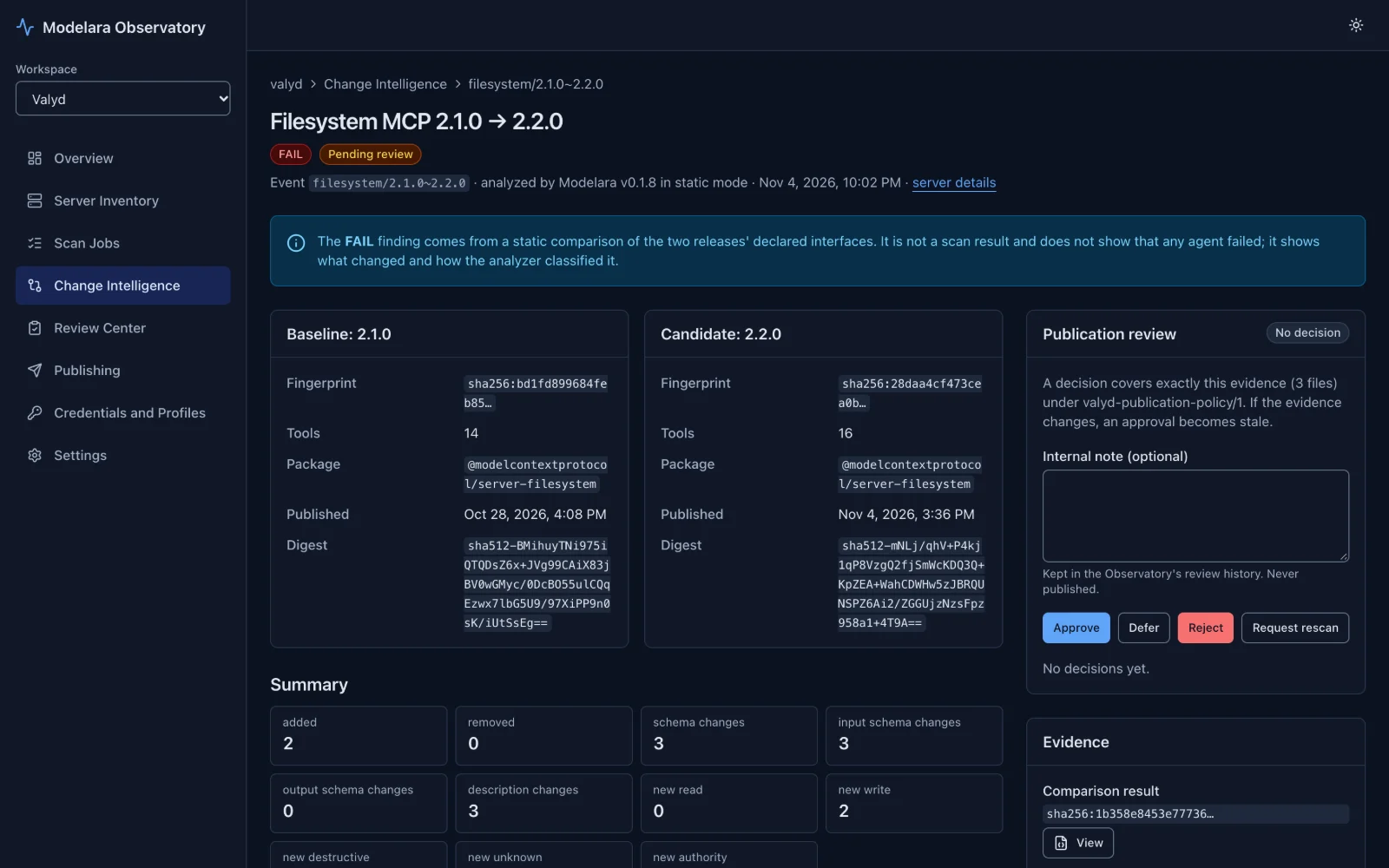
Observatory has a web application for the inventory, scans, change review and publishing. These screens show evidence that is already public: the same Filesystem MCP release history and comparison are on Valyd (opens in a new tab).
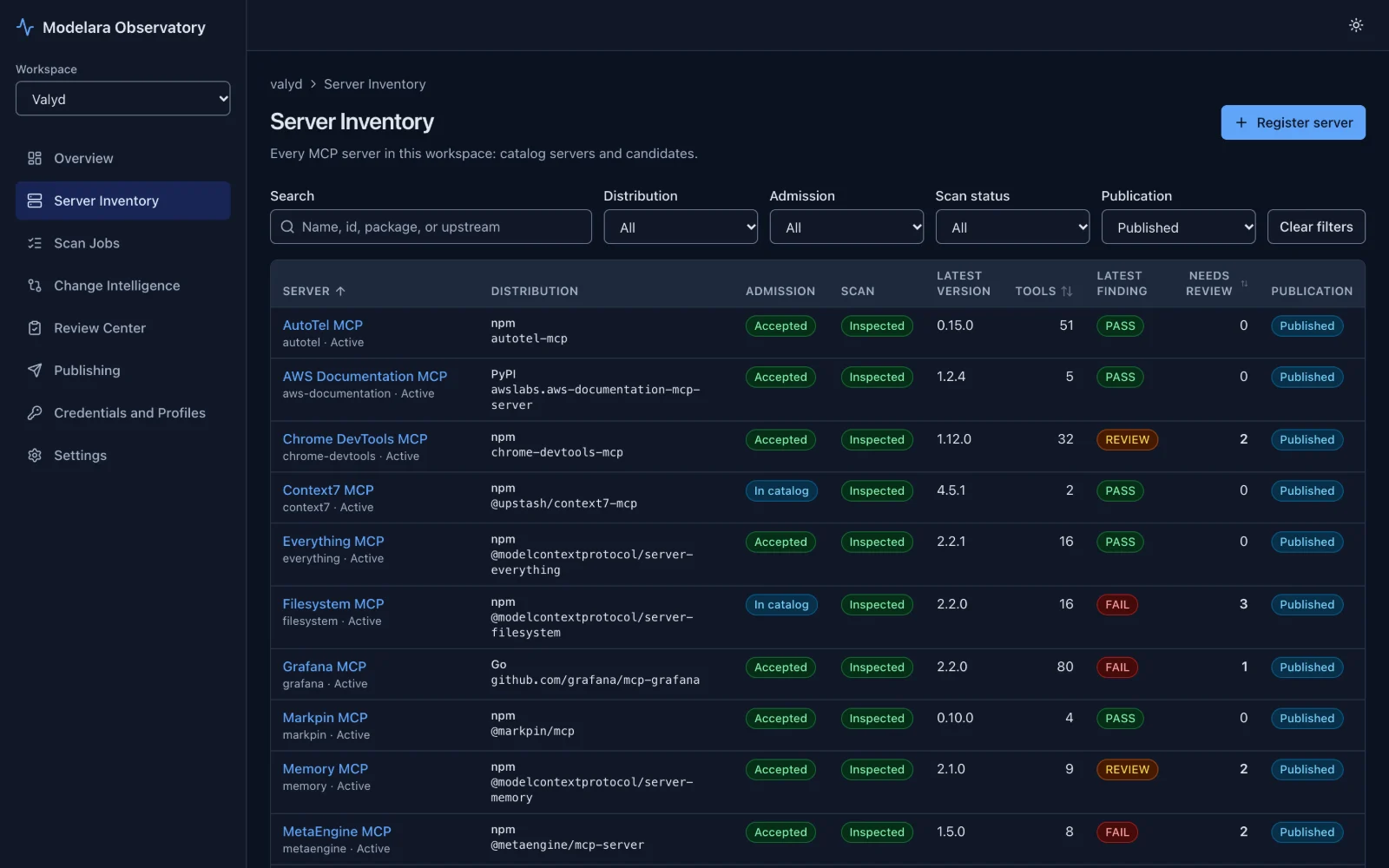
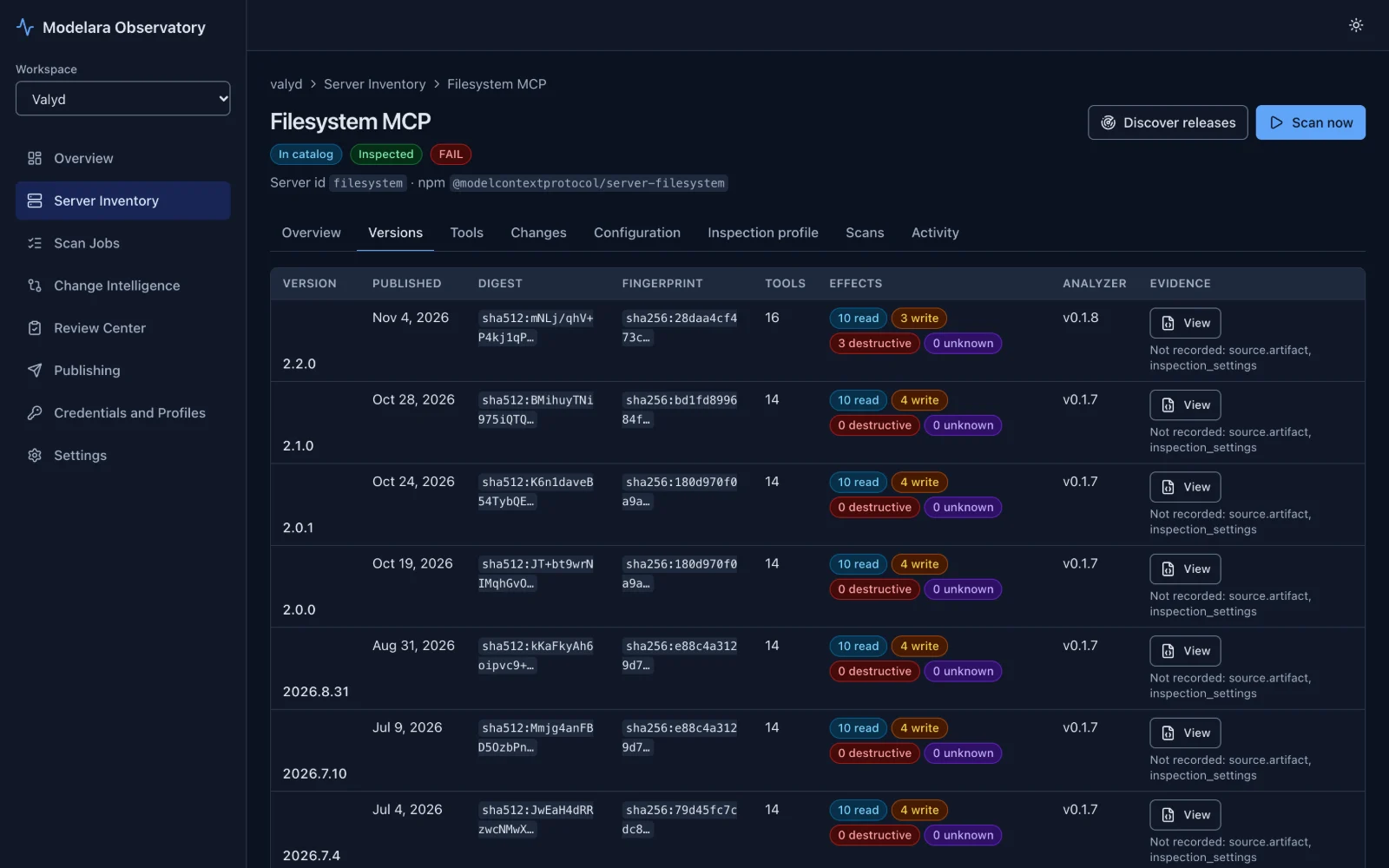
Screenshots of the Observatory web application run locally on Valyd data that is already public. The local copy had no publication destination and ran no scans. Its loopback address label was hidden; nothing else was changed.
04 Capabilities
Built for the second release, and every one after it.
A persistent MCP dependency inventory
Every tracked server and candidate in one searchable table: its distribution, admission, latest version, tool count, latest finding, open reviews and publication state. You stop rebuilding that picture from registries and notes.
Release discovery and monitoring
Inspection profiles set each server’s version selection, resource limits and schedule. Daily scans run at stable times, missed runs are recorded, and transient failures are retried with backoff instead of being reported as broken servers.
Isolated interface inspection
Third-party servers are treated as untrusted code. Each release is installed and inspected in hardened containers, with the artifact verified first, so you can look at a new release before anyone runs it next to real credentials.
Version-specific change evidence
Each comparison names its baseline and candidate artifacts, lists every tool change with the rule that flagged it, and states its own limitations. A re-published artifact under the same version is flagged as drift, not silently rescanned.
Review and approval
A review center lists what is awaiting a decision and why. Decisions carry internal notes that are never published, and a stale approval blocks publication until someone looks again.
Historical auditability
Evidence is write-once, never pruned, and checked against its SHA-256 on every read. Review decisions are appended to each result’s history, never replaced, so you can show what was known about a version, and who decided what, and when.
Recurring scans run only when an operator turns the scheduler on; it is off by default. A scan or a release discovery can always be started by hand from a server’s page.
05 Security and limitations
Untrusted code, handled as untrusted. Findings, stated with their limits.
Observatory installs and starts third-party MCP servers in order to read their interfaces, so isolation comes first. How Modelara handles security is described on the Security page.
- Rootless container isolation
- The production deployment is configured to run scan containers under a rootless Docker daemon owned by a separate, unprivileged account, apart from the account that holds Observatory’s data and credentials.
- No host execution
- Package code runs only in disposable containers, as a non-root user with a read-only filesystem, all capabilities dropped and no privilege escalation. If containers are unavailable, the scan stops instead of falling back.
- Restricted network
- The inspection container has no network. Installing a package needs outbound network to fetch it and its dependencies; that happens in a separate container, and profiles that would need network during inspection are held, not run.
- Resource limits
- Every container has memory, CPU and process limits and a timeout, and is removed after the run. Downloads have deadlines and size caps, and artifacts are verified against their published hashes or digests before use.
- Credential separation
- A package never receives the host’s environment. A scan gets a credential only through an explicit authorization for that scan or schedule, and publishing credentials are never handed to a scan worker.
- Immutable evidence
- Evidence is content-addressed and write-once. Published evidence is never rewritten, and a requested rescan never overwrites what was recorded before.
- Human-controlled publication
- Nothing is published without a current approval, a previewed batch and pre-publication checks: admission, approval, hashes, identity, credential screening, visibility and provenance.
- Containers, not virtual machines
- Containers share the host kernel and the sandbox daemon. A container escape would reach that daemon’s unprivileged account, not Observatory’s data. Observatory has no security certification.
What a finding does not tell you
- Static, not runtime
- Comparisons read declared interfaces. They cannot show that an agent workflow still works after an upgrade; that needs a behavioral test with your own tasks.
- Classifications follow the evidence
- Read, write, destructive and unknown come from a tool’s declared annotations and what its name, description and schema show. A server that misdescribes a tool can be misclassified; unknown is reported as unknown.
- Coverage is configured
- Observatory monitors only the servers it is configured to track, distributed through npm, PyPI, Go, OCI or MCPB and launched over stdio. HTTP transport is not inspected.
- A finding is not a verdict
- FAIL means the policy requires a person to look at new authority. It is not a vulnerability report, and PASS does not certify that a server is safe.
- Earlier evidence used an earlier scanner
- Before November 6, 2026, npm packages were run directly on the scanning host, with install scripts disabled. Evidence recorded before then, including some published on Valyd, was not produced in the container sandbox. It is kept as it was, not re-created.
- Not self-service
- Observatory is operated by Modelara. There is no public signup, hosted multi-tenant service, single sign-on or pricing.
06 Part of Modelara
One intelligence layer. Three ways to work with MCP interfaces.
Observatory runs the same analysis as Modelara CLI, release after release, and its approved results are what Valyd publishes.
Inspect locally
Modelara CLI
- Inspect and compare MCP interfaces on your machine
- Gate releases in CI with PASS, REVIEW and FAIL
Monitor and review
Modelara Observatory
- Monitor MCP dependencies release by release
- Manage evidence and review decisions over time
You are here
Explore publicly
Valyd
- Explore published interface intelligence
- Free, with no install or account
07 Who it is for
For teams that depend on MCP servers they don’t control.
- AI infrastructure teams
- Keep track of the MCP servers your agents run, and see when a new release adds tools or changes schemas before you roll it out.
- Platform engineering teams
- Keep one reviewed record per server and version: what was inspected, what changed, who approved it, and against which evidence.
- MCP server maintainers
- See how each release changes the interface your consumers depend on, as they would see it, before or after you ship it.
- Teams with many MCP dependencies
- Separate inventories, policies and evidence into workspaces, with schedules and resource limits set per server.
Track what changes. Understand what matters.
Observatory is operated by Modelara, and its first workspace produces the public data on Valyd. Public self-service access is not yet available: there is no signup, hosted service or pricing. You can browse its published results on Valyd today, or inspect a server yourself with Modelara CLI.